Queenstown house prices in 2026: what your home could sell for
Queenstown house prices are easy to search but harder to interpret properly. If you are looking at the average house price in Queenstown or the Queenstown median house price, the key thing to know is that different sources measure different things — sale medians, asking prices, average values, council rating values, and appraisal ranges are not the same.
That matters in Queenstown more than in many other New Zealand markets because the gap between entry-level homes, family properties, premium view homes, and prestige sales can be huge. As at early April 2026, suburb-level median sale price data from realestate.co.nz market insights pages showed Queenstown Central at about $1.53 million, Frankton at $899,000, Fernhill/Sunshine Bay at about $1.24 million, Jacks Point at about $1.43 million, and Lower Shotover at $1.7 million. At the same time, district-wide average value measures vary by source, which is exactly why this article explains the numbers before drawing conclusions.
TL;DR
- Queenstown house prices make most sense when you read them in layers: broad market trend first, suburb trend second, and recent comparable sales third.
- The average house price in Queenstown can be useful for context, but it can also be skewed by premium or trophy sales, so it should not be used on its own to set an asking price.
- REA’s appraisal guidance says appraisals must be in writing, supported by comparable sales information, and explained to the client before an agency agreement is signed.
- Settled’s guide to what your house is really worth and Settled’s “doing your homework” advice both make the same practical point: online estimates are a starting point, not the full picture.
- If you are comparing your property with council values, Queenstown Lakes District Council’s revaluation guidance explains that rating valuations exist to help distribute rates fairly; they are not a live promise of sale price.
- If you have completed major consented work, make sure the code compliance paperwork is in order, as buyers, insurers, and lenders may all care whether the work has been properly signed off.
- If you need a formal number for lending, legal, probate, or trust reasons, Settled’s planning-to-sell guidance points sellers towards a registered valuation rather than relying on an estimate or appraisal alone.
If you want a clearer idea of what your home could sell for in the current market, you can get your FREE Market Property Report through Price My Property.
What are Queenstown house prices doing right now?
Right now, Queenstown house prices still look firmer than many other parts of New Zealand, but the market is not one simple upward line. The current picture is better described as resilient and selective: premium, tightly held suburbs are performing strongly, while buyers are still comparing hard and taking time over price. That sits alongside a national market REINZ described in February 2026 as patient, with selective buyers and sellers prepared to wait for the right price.
At a suburb level, the latest available 12-month sales medians give a more useful picture than a single district-wide average. Queenstown Central sits at about $1.54 million, Fernhill/Sunshine Bay at about $1.24 million, Jacks Point at about $1.43 million, and Lower Shotover at $1.7 million, while Frankton remains a more accessible part of the local market at $899,000. Those numbers show one market with very different price bands, rather than a single “typical” Queenstown result.
The Queenstown median house price tells you more than one average
The Queenstown median house price is generally more useful for gauging the current market than a broad average, because a median is less distorted by a few very expensive sales. That matters in a district where prestige transactions can shift the headline average sharply.
What does the average house price in Queenstown really mean?
When people search for the average house price in Queenstown, they are usually trying to understand whether the market is expensive, rising, or still worth targeting as a seller. That number is fine for orientation, but it is not precise enough to price an individual property because it combines apartments, family homes, luxury stock, lifestyle properties, and premium-view sites into a single figure. Infometrics’ district measure and OneRoof’s district measure both show a very high-value market, but they still do not tell you what one three-bedroom home in Frankton or Fernhill should sell for this month.
The headline numbers readers will keep seeing
Readers will keep seeing four different types of numbers on this topic: median sale price, median asking price, average value, and council rating value (CV or RV). In Queenstown Central, for example, the latest available figures show a median sale price of $1.53 million, a median asking price of $1.6 million, a median rent of $850 per week, and a median days to sale of 32. That is a very useful market context, but it is still not a substitute for recent comparable sales and a property-specific appraisal.
If you are comparing local sales and want a more personalised estimate, a good next step is to get your FREE Market Property Report from Price My Property.
Why do different websites show different Queenstown prices?
Different websites show different Queenstown prices because they are not measuring the same thing. Some pages show median settled sales, others show current asking prices, others show modelled average values, and others show capital values for rating purposes. In New Zealand terms, that means you can be looking at a REINZ-style sale median, a portal asking median, a QV or Infometrics-style value measure, a QLDC rating value, or an agent’s written appraisal, all on the same day.
Sale price vs asking price vs online estimate vs CV
A sale price is what a buyer actually paid. An asking price is the seller’s marketing position. An online estimate is a modelled figure based on data and assumptions. A CV or RV is a council rating value used for rate purposes. An appraisal is a selling-focused estimate prepared by a licensed real estate professional, and REA says it must be written, evidence-based, and explained. A registered valuation is a formal valuation product used when a bank, lawyer, court, estate, or other process needs that higher level of formality.
Why is CV not the same as market value in Queenstown
This is especially important in Queenstown because council values can look large and still be a poor guide to today’s selling range. QLDC says rating valuations are part of a revaluation process used to ensure rates are distributed fairly. QV’s March 2025 Queenstown-Lakes revaluation release also warned that average figures were heavily skewed by the upper end of the market; it reported an average house value of $2,035,732 but a median house value of $1,610,000. That gap alone shows why sellers should be careful with any single number.
Why online estimates can miss the mark
Settled says online estimates are only a starting point because they do not fully capture conditions or improvements. In Queenstown, that limitation can be even bigger because views, sun, renovation quality, garaging, consent status, short-stay appeal, and exact street position can create large price differences within the same suburb. A model can get you into the right postcode; it cannot inspect your deck, your lake outlook, or whether your recent work has a CCC.
Queenstown suburb prices: where the market is strongest, priciest, and most affordable
Queenstown is not one market. It is a collection of smaller markets, each with its own buyer pool, stock mix, and price ceiling. That is why suburb-level evidence matters in Queenstown, not just one district-wide headline number.
How to compare the city-wide figure with the suburb-level evidence
If a reader searches for the average house price Queenstown, what they usually need next is not another district-wide average but a suburb breakdown. That is where the local picture becomes genuinely useful, because the decision to sell in Frankton is not the same as the decision to sell in Lower Shotover or Queenstown Central.
Suburb comparison table
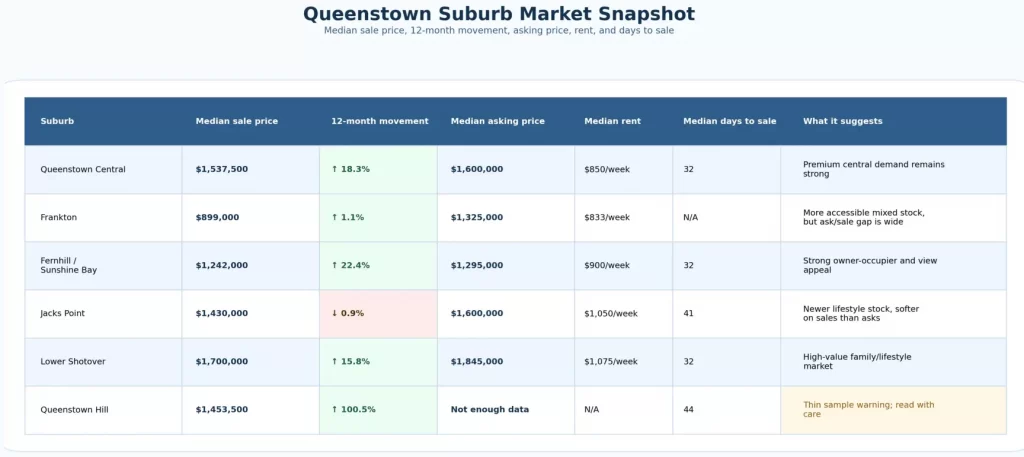
Table compiled from the latest available realestate.co.nz suburb insight pages in early April 2026. Sale median prices are supplied by REINZ, while asking and rental figures come from real estate.co.nz data. Queenstown Hill is a good reminder that low sales volumes can make one year of percentage movement look more dramatic than the lived market feels.
How readers should use the suburb table
The safest way to use this table is as context, not as a quoting tool. If your home sits in a high median suburb, that does not mean every property there should be priced at or above that level. What matters next is the shortlist of similar settled sales, the condition of your home, and the level of current competition in your price band. That is consistent with REA’s appraisal rules and with Settled’s advice that estimates should be checked against real evidence.
What actually drives Queenstown house prices?
Queenstown house prices are driven by more than just mortgage rates. Queenstown-Lakes sits well above the national market on broad value measures, and local sales data shows strong pricing in several key suburbs even while the wider NZ market remains more patient. That suggests local scarcity, lifestyle appeal, and premium-buyer demand are still doing a lot of work.
Lifestyle appeal, premium demand, and market resilience
Late-2025 reporting from OneRoof said Queenstown-Lakes’ average property value rose to about $2.13 million while many other major centres were weaker, and Colliers highlighted a central Queenstown auction result at $4 million for a two-bedroom home that drew strong interest from local and overseas buyers. Those are not everyday homes, but they do reinforce the point that lifestyle-led demand and prestige scarcity still matter here.
Scarcity, land values, and building constraints
Land scarcity is also part of the story. QV’s March 2025 revaluation release for Queenstown-Lakes said residential housing values had risen on average 18.3% since the previous revaluation and put the average land value at $1,076,925, with a median land value of $860,000. Highland values do not automatically create future growth, but they do help explain why replacement cost and location quality weigh heavily on pricing in this district.
National rates still matter, but local evidence matters more
This is still New Zealand, so mortgage costs, buyer confidence, inventory, and time on market matter. REINZ’s February 2026 report described a national market of selective buyers and longer selling times, with a national median days-to-sell of 56. Queenstown does not get to ignore that backdrop; it just tends to express it differently because of the mix of tightly held stock, lifestyle demand, and prestige sales.
Are Queenstown homes selling above or below the CV?
Both outcomes happen, which is why sellers should be careful with blanket claims. One recent market analysis from Opes Partners said the Queenstown-Lakes District was selling at about 3% above CV on average, while Colliers reported a central Queenstown auction result at nearly double the property’s capital value. Those examples are not a guarantee of typical results, but they show why CV is a poor standalone pricing method here.
Why do some homes sell above CV?
Homes tend to beat CV when they have the features buyers cannot easily replace: strong presentation, scarce views, better sun, better layout, premium design, or stronger emotional pull. Staircase’s local commentary on CV in Queenstown makes the same practical point, noting the importance of recent comparable sales, presentation, architectural features, views, layout, and buyer urgency.
Why do some homes sell below CV?
Homes can also sell below CV if they are dated, poorly presented, awkwardly laid out, affected by consent or maintenance issues, or simply launched at the wrong price for the current buyer pool. That is why a lower CV does not automatically mean a lower sale price, and a higher CV does not guarantee buyers will meet it. The market still decides.
If you want to move from general market data to a more property-specific view, you can get your FREE Market Property Report and see what your home could be worth.
What is the outlook for Queenstown house prices?
My base-case reading is that Queenstown house prices look more likely to stay stable-to-firm than to run away in a boom. That is an inference from the current mix of evidence: the national market is still selective, but Queenstown-Lakes has remained far above the national average on broad value measures and several local suburbs are still posting solid 12-month sale performance.
What could support prices?
The main supports are clear enough: Queenstown remains a high-value district, local premium demand has not vanished, and multiple suburb pages still show healthy sale medians and, in several cases, strong rent levels. Lower Shotover, Jacks Point, and Queenstown Central all illustrate that better-than-average stock can still command strong money.
What could cap prices?
The main limits are also clear: buyers remain choosy, some suburbs show a meaningful gap between asking and achieved sale levels, and time on market is not ultra-fast. Frankton and Jacks Point are good examples of why sellers still need to be realistic: the latest asking medians there sit above the sale medians, which usually means pricing discipline still matters.
What this means for sellers over the next few months
For sellers, the practical takeaway is not “rush” or “wait”, but “sanity-check your range properly”. Start with the suburb trend, then compare five to ten recent settled sales, then pressure-test that against current competition and a written appraisal. That is the method that best fits both the local market and New Zealand practice.
How sellers should use Queenstown price data without getting misled
Use the four-step approach
A practical NZ approach is simple. First, use the market-level data to understand the broad direction. Second, use suburb-level data to understand the local band your property sits in. Third, build a shortlist of genuinely comparable recent settled sales. Fourth, pressure-test your conclusion with a written appraisal before choosing an asking strategy or sale method. That is also the logic Price My Property uses in its own CMA and pricing guidance.
When a registered valuation makes more sense
If the number is needed for refinancing, probate, court work, trusts, or other formal purposes, step out of the appraisal lane and into the registered-valuation lane. Settled’s guidance makes that distinction clearly, and Price My Property’s own NZ valuation content does too.
The practical next step for a homeowner
For a seller who may list this year, the best next step is not to chase the biggest number online. It is to get a realistic range, compare it with local evidence, and only then choose a price strategy.
If you want to move from general market data to a more property-specific view, you can get your FREE Market Property Report to see what your home could be worth in the current Queenstown market.
FAQs
Q: What is the average house price in Queenstown right now?
A: That depends on which measure you mean. Infometrics showed the average current house value in Queenstown-Lakes District at $1,671,771 in December 2025, while OneRoof reported the district’s average property value at about $2.13 million late in 2025. Those figures are useful for context, but they are not the same as a suburb’s median sale price or a likely selling range for one home.
Q: What does the median house price Queenstown-wide actually tell you?
A: The median house price Queenstown readers should pay attention to is the one attached to the market they are actually comparing against. In practice, suburb medians are usually more useful than one district-wide headline because they better reflect the homes buyers are cross-shopping. That is why Queenstown Central, Frankton, Jacks Point, Fernhill/Sunshine Bay, and Lower Shotover should all be read separately.
Q: Is the average figure the same as the market value?
A: No. An average figure is an aggregate measure. The market value of a single property depends on recent comparable sales, condition, improvements, buyer demand, and live competition. Settled says online estimates are only a starting point, and REA requires appraisals to be supported by comparable evidence and explained.
Q: Are Queenstown house prices rising in 2026?
A: So far, the safest answer is that some parts of the district are still showing firm pricing, but the market is not uniformly surging. The suburb data shows strong 12-month movement in places such as Queenstown Central, Fernhill/Sunshine Bay, and Lower Shotover, while Jacks Point has been softer on the latest available sales measure. Nationally, REINZ still describes a more patient and selective market, so local strength does not remove the need for realistic pricing.
Q: Why is Queenstown property so expensive?
A: The current evidence points to a mix of high land values, constrained supply, strong lifestyle appeal, and an active premium segment. QV’s revaluation figures showed very high land values in Queenstown-Lakes, and district-wide value measures remain well above the New Zealand average.
Q: Are Queenstown homes still selling above CV?
A: Some are, and some are not. The better way to phrase it is that CV remains background context, not the deciding number. Local commentary and recent examples both show that comparable sales, presentation, views, layout, and buyer urgency are usually more important than the rating value itself.
Q: Should I trust online property estimates?
A: Trust them as a first-pass guide, not as the last word. Settled explicitly states that online estimates should be used only as a starting point, as they cannot fully account for a property’s condition or any improvements.
Q: Do I need an appraisal or a registered valuation?
A: If you are selling and want a realistic market range, start with an appraisal supported by recent comparable sales. If the number is for the bank, probate, legal, or another formal requirement, use a registered valuation. That distinction is consistent across REA and Settled guidance.
Final thoughts
The best way to read Queenstown house prices is to stop asking for one magic number and start asking better questions: which measure is this, which suburb does it really reflect, what similar homes have sold for, and does a written appraisal support the range? That approach is the cleanest fit for the New Zealand market, the cleanest fit for Queenstown, and the best way to avoid misleading homeowners with a number that sounds precise but is not decision-ready.