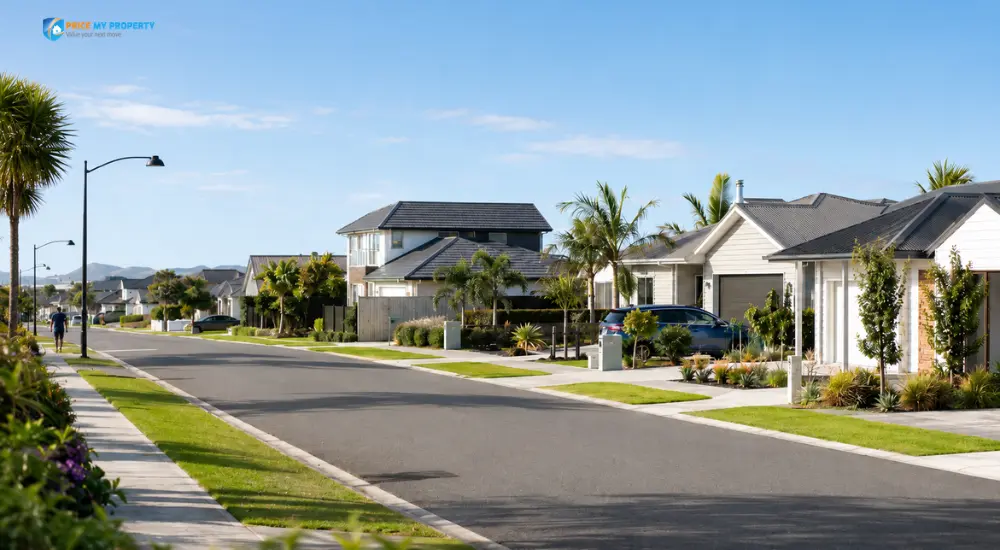
Average House Price Papamoa 2026: What Homeowners Should Know
Papamoa house prices can look straightforward when you search for a single suburb average, but that number rarely tells the full story. A coastal home near Papamoa Beach, a newer family home in Papamoa East, an older property needing work, and a low-maintenance townhouse can all sit in different price bands. This average house price Papamoa guide explains current public Papamoa property figures at the time of writing, why different property data sources show different numbers, and how local homeowners can use the data before selling.
TL;DR: Papamoa house prices at a glance
- Public Papamoa price figures vary because some sources measure the average house value, while others measure the median sale price, median asking price, rent, or a rating valuation.
- As at June 2026, public average-value data lists Papamoa’s average house value at $867,150, while listing-market data shows a 12-month median sale price of $925,662 and a median asking price of $966,000. Use each average house price Papamoa figure as a market benchmark, not a valuation for your own home.
- Papamoa sits within Tauranga City, so homeowners should compare local suburb data with wider Tauranga and Bay of Plenty house prices before choosing a selling range.
- Before selling, check official selling guidance, review Tauranga City Council property values and recent sales, and understand what a LINZ record of title can show.
For a property-specific starting point, request a free Market Property Report from Price My Property to compare your home with recent local sales and current competing listings.
What is the average house price Papamoa?
The average house price Papamoa depends on the source and the metric being used. Public average-value data reports Papamoa’s average house value at $867,150, while listing-market data reports a 12-month median sale price of $925,662, a median asking price of $966,000, and a median rental price of $742 per week.
Those figures are useful, but they do not all mean the same thing. An average house value is an estimated value across the suburb. A median sale price is based on actual sales and shows the middle sale point over a period. A median asking price reflects what sellers are asking, not necessarily what buyers are paying.
| Data type | Metric | Current figure | What is it useful for |
| Public average-value data | Average house value | $867,150 | Broad suburb value benchmark |
| Listing-market data | Median sale price | $925,662 | Recent sales market snapshot |
| Listing-market data | Median asking price | $966,000 | Current seller expectations |
| Listing-market data | Median rent | $742 per week | Rental market context |
| Council rating data | Rating valuation / CV | Varies by property | Rates and valuation-date context |
Before relying on a suburb average, it is worth getting a free Market Property Report from Price My Property to compare your Papamoa home with recent local sales and current competing listings.
Why do Papamoa house price sources show different numbers
Papamoa property data can feel confusing because property data sources answer slightly different questions.
An average house value is useful for understanding the suburb’s general value level, but it may include homes that have not sold recently. It can also be affected by the mix of housing in the area.
A median sale price comes from actual transactions. This is often a stronger market signal, but it can still move around depending on what was sold during the period. If larger, newer or beach-adjacent homes sell, the median can rise even if ordinary family homes have not changed much.
A median asking price shows what sellers are asking. It is useful when checking your competition, but asking prices are not proof of market value. Buyers negotiate based on recent sales, competing listings, condition, and urgency.
A council rating valuation is different again. Tauranga City Council explains that rating valuations are based on market value at a particular point in time, with the last citywide revaluation based on the property sales market on 1 May 2023. Capital value is part of the council valuation picture, but it should not be treated as today’s sale price.
Online estimates can also miss renovations, deferred maintenance, views, layout, street appeal, title issues and buyer demand in your exact price bracket. If the online estimate for your Papamoa property feels too broad, Price My Property can help you get a local, agent-backed market report rather than relying on a single automated number.
Papamoa vs Papamoa Beach: why the distinction matters
Many people search for Papamoa and Papamoa Beach as if they were the same market, but property data sources may treat them differently. That matters because beach proximity, housing age, land size and lifestyle appeal can affect buyer behaviour.
The public average-value data list Papamoa Beach’s average house value at $1,074,100, which is higher than the same source’s Papamoa average house value figure. This does not mean every Papamoa Beach home is worth more than every Papamoa home. It simply shows why sellers should compare like with like.
A home close to the beach should usually be tested against other coastal or lifestyle-driven listings. A newer home in a family subdivision may need a different comparable-sales set. An older home needing work should not be priced at the same level as renovated homes unless realistic condition adjustments are made.
For sellers, the key point is simple: your suburb label matters, but your comparable buyer segment matters more.
Papamoa in the wider Tauranga property market
Papamoa is part of Tauranga City, so its property market should be viewed within the wider Tauranga picture. Buyers may compare Papamoa with Mount Maunganui, Arataki, Welcome Bay, Bethlehem, Pyes Pa, or Te Puke, depending on lifestyle, commute, school needs, and budget.
For a deeper city-level view, read Price My Property’s guide to Tauranga house prices 2026. That wider context matters because Tauranga is not one single property market. Coastal homes, established suburbs, new-build pockets and more affordable inland areas can all behave differently.
Mount Maunganui is a useful comparison because many buyers see it as a premium coastal market. Listing market data currently shows that Mount Maunganui’s 12-month median sale price is higher than Papamoa’s on the same platform. Papamoa may appeal to buyers who want coastal access, family-friendly housing, and proximity to Tauranga without necessarily paying Mount Maunganui-level prices.
Papamoa and the wider Bay of Plenty market
Papamoa also sits within the wider Bay of Plenty region, but regional averages can hide large local differences. Tauranga, Mount Maunganui, Papamoa, Rotorua, Whakatāne, Kawerau and Ōpōtiki all attract different buyer groups and price points.
For broader context, see Price My Property’s full Bay of Plenty house prices 2026 guide. The regional view is helpful, but it should be used only as background. A Papamoa seller should not price a home at the Bay of Plenty average. The stronger approach is to start with Papamoa, then narrow the comparison to property type, land, condition, age and location.
Use the regional guide for context, then rely on recent comparable sales to understand what your own home could realistically achieve.
What affects house prices in Papamoa?
Several local factors can shift a Papamoa home above or below the suburb average.
Distance to the beach is one of the clearest value drivers. Homes with stronger beach access or coastal lifestyle appeal may attract different buyers from homes further inland.
Property age and build type also matter. Newer homes, original-condition houses, renovated family homes and townhouses should not all be grouped together.
Section size and usability can be more important than land area alone. Buyers will look at parking, outdoor living, sun, privacy and whether the section works for children, pets, boats or motorhomes.
Condition and presentation can make a major difference. Fresh paint, updated kitchens and bathrooms, good flooring, effective insulation, ventilation, moisture control, tidy landscaping and clean exterior maintenance can all improve buyer confidence.
Current competition matters too. Buyers do not compare your home with a spreadsheet. They compare it with the other homes they can inspect this weekend. A Price My Property Market Report can help connect suburb-level data with the real features buyers are likely to notice in your home.
How to estimate what your Papamoa home could sell for
The best way to estimate your Papamoa home’s likely sale range is to move from broad data to specific evidence.
Start with public market benchmarks. Use average values, median sale prices, asking prices and council data to understand the general market.
Then review recent comparable sales. The best comparisons are usually homes in the same buyer segment, with similar bedroom count, floor area, land use, age, condition, parking, outlook and beach proximity. Try not to compare a renovated four-bedroom coastal home to a smaller inland property that needs work.
Next, compare your home with current listings. Sold properties show what buyers have paid. Current listings show what buyers can choose instead. If your home is priced above similar active listings, it needs a clear reason.
Finally, adjust for condition and presentation. Buyers notice things that averages cannot see: a tired roof, a dated kitchen, road noise, dampness, sun exposure, privacy, storage, landscaping, and the quality of recent renovations.
If you are preparing to sell, start with a free Price My Property report, then use it alongside recent Papamoa sales before choosing your price strategy.
Should Papamoa homeowners sell now or wait?
There is no single answer for every Papamoa homeowner. The right decision depends on your goals, mortgage position, next move, property condition and local competition.
Selling now may make sense if you are upsizing, downsizing, relocating, reducing debt, moving closer to family, or trying to sell before buying elsewhere. It may also make sense if your property is well presented and there are few similar homes competing in your price bracket.
Waiting may make sense if the home needs obvious repairs, if your price band has heavy competition, or if you need time to clean up legal, consent, title or maintenance issues. Official selling guidance notes that sellers should think carefully about major renovations, as they may not always recoup the cost before selling.
The stronger question is not always “Should I sell now?” It is “What evidence supports my price if I list now?”
Common mistakes when reading the average house price Papamoa data
The first mistake is treating the suburb average as your home’s value. Averages are useful, but they hide property differences.
The second mistake is comparing Papamoa and Papamoa Beach without context. A coastal home and an inland family home may appeal to different buyers.
The third mistake is using asking prices as proof. Asking prices show expectations. Sold prices show what buyers actually paid.
The fourth mistake is relying too heavily on the CV. Council rating valuations have a valuation date and are not live sale prices.
The fifth mistake is ignoring current competition. Even a fair price can struggle if buyers have better-presented options for the same money.
To get a clearer idea of where your home sits, request a free Market Property Report from Price My Property and compare your property against current local evidence.
Final thoughts: what Papamoa house prices really mean for sellers
The average house price Papamoa is a helpful starting point, but it is not the number your home will automatically sell for. Median sale price, average value, asking price, CV and online estimate tools all answer different questions.
For homeowners, the practical approach is to use suburb data as context, then price from recent comparable sales and current competing listings. Pay close attention to Papamoa versus Papamoa Beach, beach proximity, home condition, land usability and presentation.
If you are thinking about selling, request a free Market Property Report from Price My Property and use it to build a realistic, evidence-based price range before you commit to a campaign.
FAQs about Papamoa house prices
Q: What is the average house price Papamoa?
A: Public average-value data currently lists Papamoa’s average house value at $867,150. The listing market data lists Papamoa’s 12-month median sale price at $925,662. These are different measures, so use them as benchmarks rather than a valuation for your own home.
Q: Why do Papamoa house price figures vary between sources?
A: They vary because some sources use the average value, some use the median sale price, some use the asking price, and others use automated estimate models or council rating data.
Q: Is Papamoa Beach more expensive than Papamoa?
A: Public average-value data suggests Papamoa Beach can sit above Papamoa, but sellers should still compare similar properties rather than relying only on suburb names.
Q: Is CV the same as market value in Papamoa?
A: No. CV is part of a council rating valuation based on a set valuation date. It can be a useful background, but sellers should rely more heavily on recent comparable sales and current buyer demand.
Q: How do I estimate what my Papamoa home is worth?
A: Start with public price data, then compare recently sold local properties, active listings, condition, land, location and buyer appeal. A local agent-backed market report can help narrow the range before selling.