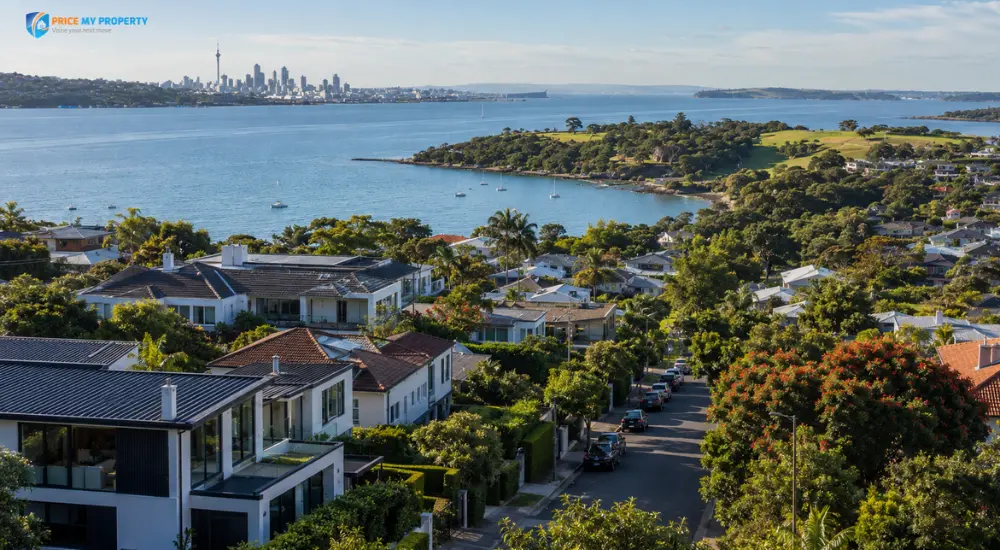
Orakei House Prices 2026: Property Values, Trends and Seller Guide
Orakei house prices are difficult to judge by a single suburb-wide number. A waterfront home, a renovated family property, an older house on valuable land, and an apartment can all sit in the same suburb but attract very different buyers and have very different sale expectations. That is why Orakei homeowners need more than a quick online estimate before deciding whether to sell, refinance, renovate or wait.
This guide explains how to interpret property values in Orakei in 2026, why different websites may show different figures, what affects local property values, and how sellers can build a more realistic view of their home’s value.
TL;DR: Orakei house prices at a glance
- Orakei house prices are best viewed as a range rather than a single fixed number, because views, land size, property type, condition, and street position can significantly affect value.
- Online property estimates are useful for early research, but should be treated as a starting point rather than a final answer.
- CV or RV is not the same as market value. Rating valuations are overseen by LINZ through the Valuer-General, but they are mainly used for rating purposes.
- If you are preparing to sell, a written real estate appraisal must reflect current market conditions and comparable sales, which is especially important in a varied suburb like Orakei.
- Orakei should be read in the context of the wider Auckland property market, but its premium streets, coastal position and housing mix mean it can behave differently from the broader Auckland averages.
For a property-specific starting point, Orakei homeowners can get a free property report through Price My Property and compare their home with recent local sales.
What are Orakei house prices doing in 2026?
Orakei remains one of Auckland’s higher-value residential suburbs, but the headline numbers only tell part of the story. Public property websites may show average house value, median sale price, median asking price, recent sales, current listings or an automated estimate. These figures are useful, but they are not measuring the same thing.
An average house value can be influenced by premium homes, especially in a suburb with harbour views, large sites and prestigious addresses. A median sale price reflects the middle point of recently settled sales, but it can shift depending on what types of homes were sold during that period. Asking prices show seller expectations and current competition, but they do not always match final sale prices.
This matters in Orakei because the suburb has a broad range of property types. Some buyers are looking for prestige homes with views, privacy and land. Others are comparing apartments, townhouses, lock-and-leave homes or older properties with renovation potential. One suburb’s average cannot capture all those differences.
Before you anchor your expectations to a suburb average, it can help to request a free Market Property Report and see how your own Orakei property compares with recent local sales.
Why is one Orakei house price number not enough
When people research property values in Orakei, they often want a simple answer. The challenge is that property value is shaped by more than the suburb name. Two homes close to each other can appeal to different buyer groups and sell at very different levels.
Here is how the main price measures differ:
| Price measure | What it means | Best used for | Main limitation |
| Average house value | A broad estimated value across the suburb | General market context | Can be skewed by expensive homes |
| Median sale price | The middle point of recent sales | Recent market evidence | Depends on what sold in that period |
| Asking price | What sellers are currently asking | Understanding competition | May not equal final sale price |
| CV/RV | Council rating valuation used for rates | Rates context | Not a live market valuation |
| Online estimate | Algorithm-based estimate | Quick research | Cannot fully assess condition or upgrades |
| Agent appraisal | Market-based selling estimate | Preparing to sell | Should be supported by comparable sales |
| Registered valuation | Formal valuation | Lending, legal or formal purposes | Usually paid and situation-specific |
For sellers, recent comparable sales usually matter more than broad suburb figures. A renovated four-bedroom home with garaging, sun and views should not be compared too closely with an unrenovated home on a different site. Likewise, a premium waterfront or elevated property may appeal to a different buyer pool than an entry-level apartment.
CV or RV should also be handled carefully. It may appear in property research, and buyers may look at it, but it is not a guarantee of market value. It may not capture recent improvements, current buyer demand, presentation, maintenance or unique property features. For a broader breakdown of valuation methods, Price My Property also explains how much your house is worth in NZ.
What affects house prices in Orakei?
Several local factors can influence Orakei property values. The first is position. Homes with harbour views, elevation, privacy, or easy access to the waterfront can attract stronger buyer attention than similarly sized homes without those features. In Orakei, outlook and street position can be a major part of the value story.
Land also matters. A larger freehold site, usable outdoor space, development potential or a desirable orientation can lift buyer interest. However, bigger land does not automatically mean a higher price if the property has difficult access, poor layout, slope issues or significant maintenance concerns.
Condition is another key factor. Buyers often pay more confidently for homes where major work has already been well completed. Modern kitchens, updated bathrooms, good insulation, heating, drainage, roofing and outdoor living can all influence perceived value. On the other hand, buyers may discount properties where they see uncertain renovation costs or compliance risks.
Parking and access are especially important in established Auckland suburbs. Garaging, off-street parking and easy entry can make a property more practical for families, downsizers and professionals. These features can help a home compete more strongly against nearby listings.
Lifestyle also plays a role. Orakei offers access to the eastern bays, Tamaki Drive, Orakei Basin, Okahu Bay, nearby cafés, coastal walks and central Auckland connections. Buyers are pricing not only the house but also the daily lifestyle that comes with it.
These details are exactly why a suburb average can only go so far. Get a free property report from Price My Property to compare your home against similar Orakei sales, not just the suburb as a whole.
Orakei and the wider Auckland property market
Orakei sits within Auckland, so wider Auckland market conditions still matter. Interest rates, lending confidence, buyer sentiment, listing volumes, and employment confidence can all influence buyer activity. When Auckland buyers feel cautious, they may take longer to make decisions, negotiate harder or compare more properties before committing.
However, Orakei does not always move in exactly the same way as the broader Auckland. Premium suburbs can be shaped by smaller numbers of high-value sales. If a few expensive homes sell in one period, the suburb’s average or median may lift. If more apartments, townhouses or lower-priced properties sell in another period, the median may soften, even if demand for quality family homes remains steady.
This is why sellers should read Auckland-wide trends as context rather than a direct valuation tool. The wider city helps explain the market’s mood, but your likely sale price still depends on your home, your street, your competition, and the buyers active at the time you sell.
Orakei compared with nearby suburbs
Many buyers looking at Orakei will also compare nearby Auckland suburbs such as Mission Bay, Remuera, Parnell, Kohimarama, St Heliers and Meadowbank. Each area has its own appeal, and those comparisons can affect how buyers judge value.
| Nearby area | Buyer appeal | How does it compare with Orakei |
| Mission Bay | Beach lifestyle, apartments and family homes | Strong coastal appeal with a different housing mix |
| Remuera | Established prestige, schools and larger homes | More inland prestige market with strong family demand |
| Parnell | City-fringe convenience and character homes | Appeals to buyers wanting central access |
| Kohimarama | Eastern Bays lifestyle and family homes | Often compared by coastal and school-focused buyers |
| St Heliers | Premium seaside living | Competes for high-end coastal buyers |
| Meadowbank | Convenience, transport and family living | Often has a broader price mix than Orakei |
For sellers, these comparisons matter because buyers rarely look at only one suburb. A buyer may view an Orakei home, then compare it with a Remuera property offering more land, a Mission Bay home closer to the beach, or a Parnell property closer to the city. Your pricing strategy needs to consider what else buyers can purchase for similar money.
Are Orakei house prices rising or falling?
This is one of the most common questions homeowners ask, but the answer depends on the source, time frame and type of property being measured. Short-term suburb data can be noisy, especially in areas where sales volumes are low and individual high-value sales can skew the numbers.
This can make short-term trends look sharper than the underlying buyer demand for comparable homes. Neither result necessarily tells you what your own home is worth.
The better question is: what is happening with comparable properties? Look at homes with similar land size, condition, layout, street appeal and buyer profile. Check how long they took to sell, whether they changed price during the campaign, and whether the final result was above or below expectations.
Current listings can also be useful, but they should be treated carefully. A listed price, an auction guide, or a “by negotiation” campaign indicates how a seller is entering the market. It does not prove what buyers will actually pay.
If you are deciding whether to sell now or wait, get a clearer local view with a free Market Property Report based on recent comparable sales and local agent insight.
Is Orakei a good suburb to buy in?
For many buyers, Orakei’s appeal comes from location. It offers access to the eastern bays, central Auckland, waterfront amenities and established residential streets. It can suit families, professionals, downsizers and prestige buyers, depending on the property type.
However, “good suburb” does not automatically mean every property is a good buy. Buyers still need to check the title, building condition, LIM, consents, flood or slope considerations, renovation history and comparable sales. They should also consider whether they are paying for features that matter to future buyers, such as views, parking, sun exposure, privacy, outdoor living, and flexible spaces.
For sellers, this buyer thinking is useful. The stronger your home’s practical and emotional appeal, the easier it may be to justify its position within the Orakei market. A well-presented home that clearly answers buyer concerns can often compete more strongly than one that leaves too many questions unanswered.
Is 2026 a good time to sell in Orakei?
The right time to sell depends on your property, your personal plans and the level of competition in the market. Some homeowners sell because they are upsizing, downsizing, moving for work, changing family arrangements or releasing equity. Others wait because they want more certainty or because their home needs preparation before going to market.
In Orakei, presentation and pricing are both important. Premium buyers tend to be selective, and they may compare your property with several nearby suburbs before making a decision. If the price expectation is too far ahead of the evidence, the campaign may lose momentum. If the home is priced and presented well, it is easier for buyers to act with confidence.
The sale method also matters. Auction, tender, deadline sale, and negotiation can all work in different situations, but the right approach depends on the property, likely buyer demand, and the current market mood. A unique high-end home may need a different campaign from a townhouse or apartment.
Before choosing a sale method or setting a price guide, homeowners can get a free written Market Property Report to understand where their Orakei property may sit in the current market.
How to estimate what your Orakei home could sell for
Start with recent comparable sales. Look for homes that are genuinely similar, not just nearby. Compare land size, floor area, number of bedrooms, garaging, condition, renovation quality, outlook, sun, access, and street position.
Next, check the current competition. If there are several similar homes on the market, buyers may have more choices. If stock is limited and your property has desirable features, you may be in a stronger position. However, avoid treating asking prices as confirmed values. Some listings are priced optimistically, and some campaigns adjust as buyer feedback comes in.
Then review CV/RV and online estimates, but keep them in context. They can help you understand how the market sees your property at a broad level, but they cannot fully assess presentation, maintenance, improvements or buyer emotion.
Finally, get local advice before making major decisions. This is especially important if you are considering renovations before selling. Spending heavily without understanding what buyers in your segment value can lead to overcapitalising.
Common mistakes when reading Orakei house price data
One common mistake is relying on one website as the final answer. Every platform uses different data, update cycles and methods. A better approach is to compare several sources, then test them against recent comparable sales.
Another mistake is comparing unlike properties. A home with harbour views, strong sun and garaging should not be priced like an apartment sale or an unrenovated property on a compromised site. Orakei has too much variation for loose comparisons.
Sellers also need to test asking prices against actual sale evidence. A property can be listed at one level and sell at another. The final result is shaped by buyer demand, negotiation, competition, urgency and campaign quality.
The biggest mistake is assuming a broad suburb number tells you what your own home is worth. Suburb-level data is useful for market context, but it is not a substitute for a property-specific assessment.
How Orakei homeowners can prepare before selling
Good preparation can make a major difference. Start by gathering key documents, including your title, LIM, consent records, warranties, renovation information and any relevant reports. Buyers feel more confident when important details are easy to verify.
Next, look at the presentation. Small improvements such as cleaning, decluttering, minor repairs, garden tidy-ups and better lighting can help buyers focus on the home rather than its flaws. In a premium suburb, presentation should feel considered, but that does not mean every seller needs a major renovation.
Be careful with expensive pre-sale work. A new kitchen, bathroom or landscaping project may help in some cases, but not always. The question is whether the likely increase in buyer interest justifies the cost, time and risk.
It also helps to understand your likely buyer. Are you selling to families, downsizers, investors, professionals, developers or prestige buyers? The more clearly your campaign speaks to the right buyer group, the stronger your strategy can be.
For a practical next step, Price My Property can connect you with a local licensed agent so you can request your free Market Property Report before deciding how, when or whether to sell.
Final thoughts: use Orakei house prices as a guide, not a guarantee
Suburb-level Orakei data is useful for understanding the broad market, but it should not be treated as a direct valuation of your own home. In a suburb where views, land, street position, renovation quality, parking, buyer profile and nearby competition can all shift value, one number is rarely enough.
The smarter approach is to use public data as a starting point, then compare your property with recent sales that genuinely match. From there, local advice can help you decide whether to sell now, prepare further, adjust your expectations or watch the market for a little longer.
FAQs about Orakei house prices
Q: What is the average house price in Orakei?
A: The average house price in Orakei depends on the source and measurement being used. Some platforms use the average estimated value, while others show the median sale price, asking price, or recent sales data. For a more useful estimate, compare your home with recent similar sales.
Q: Are property prices in Orakei going up or down?
A: Short-term Orakei house price data can vary depending on which homes have sold recently. A few high-end or low-priced sales can skew the suburb figure, so homeowners should look at comparable sales rather than relying on a single trend line.
Q: Why do Orakei house price figures differ between websites?
A: Different websites use different datasets, time frames and valuation models. One may focus on settled sales, another on asking prices, and another on automated estimates. That is why the figures often differ.
Q: Is CV the same as market value in Orakei?
A: No. CV or RV is mainly used for council rating purposes. It can be useful context, but it should not be treated as a current market valuation or a guaranteed sale price.
Q: What affects Orakei property values the most?
A: Major value factors include land size, views, street position, home condition, renovation quality, parking, sun, privacy, zoning, access and proximity to lifestyle amenities such as the waterfront and eastern bays.
Q: Is Orakei more expensive than Mission Bay?
A: It depends on the property type, street, views and sales period. Orakei and Mission Bay can attract overlapping buyer groups, but each suburb has a different housing mix and lifestyle appeal.
Q: How do I find out what my Orakei home could sell for?
A: Start with recent comparable sales, review online estimates carefully, treat CV/RV as context only, and get a local market-based appraisal or property report before making selling decisions.